
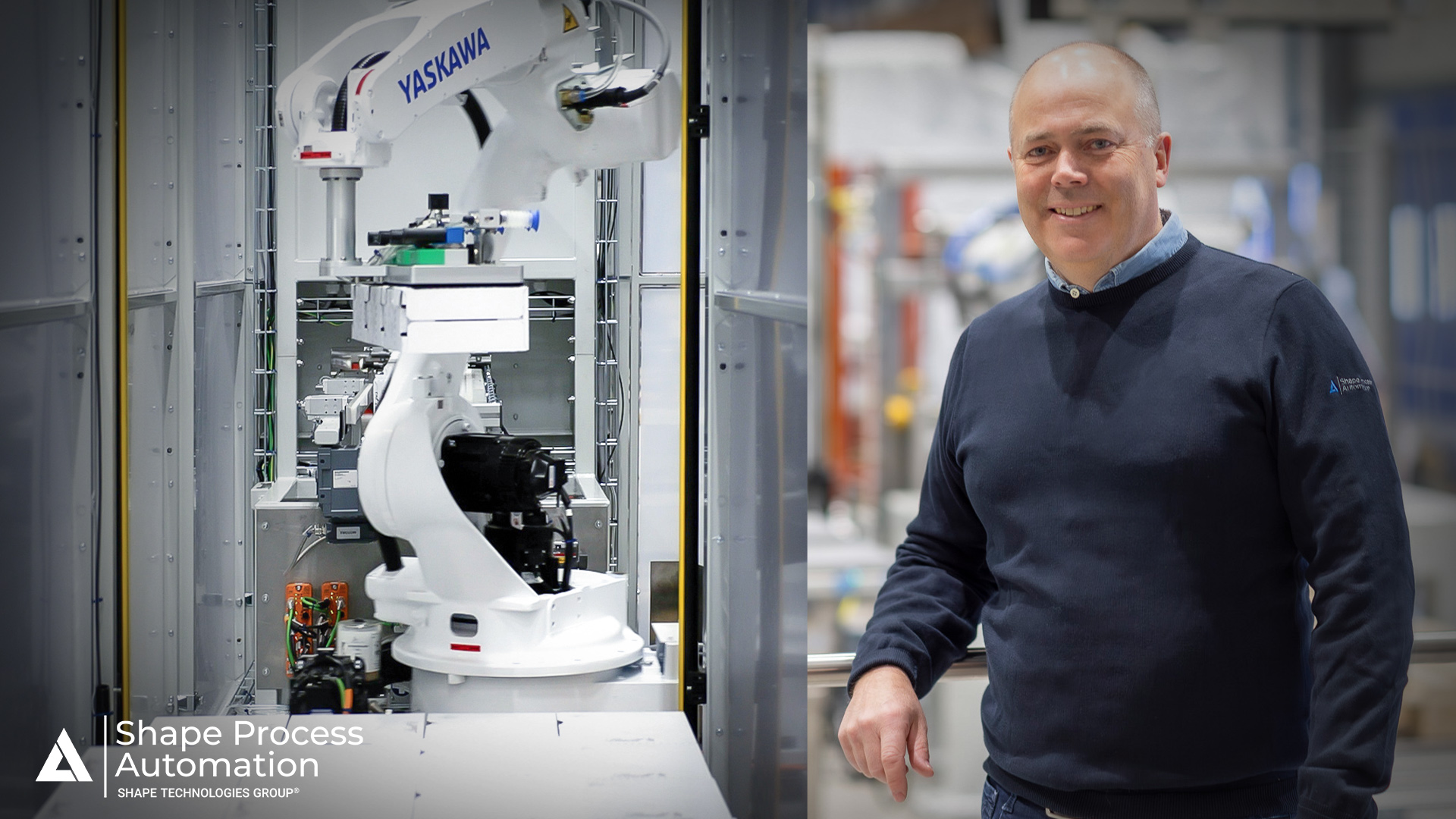
Industrial robot or cobot for palletizing: how do you choose the right solution?
When products leave the production line, the palletizing operation needs to keep pace. But which solution is the better fit: an industrial robot or a collaborative robot, commonly known as a cobot? We asked Jonas Persson, CEO of Shape Process Automation, about throughput, operational reliability and why the entire production flow should guide the choice.
Summary: What determines the choice between an industrial robot and a cobot?
An industrial robot is often a strong option when palletizing requires high throughput, heavier payloads and headroom for increased production volumes. A cobot may be suitable when the throughput requirements and working environment align with the robot’s capabilities. The decision should always be based on the complete solution: products, end-of-arm tooling, safeguarding, pallet handling and the required production flow.
When do you choose an industrial robot for palletizing?
– When we see that a customer needs high throughput, greater payload capacity or the ability to handle multiple product flows, an industrial robot is often a strong option. But we start by understanding the production process.
– Which products need to be handled? At what rate do they arrive? What do the pallet patterns look like, and what happens when a pallet is full? We also need to understand whether the customer plans to increase production. From there, we can select a solution that fits the application.
Why is the robot’s maximum speed not the whole answer?
– Because the customer needs a certain number of completed pallets, not simply a robot that moves quickly.
– Each cycle consists of several operations. The robot must pick, transfer and place the product, then be ready for the next pick. The cycle may also need to include slip-sheet handling and pallet changes. That is why we have to evaluate the actual throughput of the complete cycle.
– We also need to account for variations in the product flow. If products arrive at a higher rate during certain periods, the solution must be able to handle those peaks without palletizing becoming a bottleneck.
How does safety affect a cobot’s throughput?
– A cobot is designed to enable collaborative operation with people. However, how it may operate in a specific installation depends on the risk assessment of the complete application.
– Its speed may need to be limited. Depending on the safety concept, the robot may also need to slow down or stop when a person approaches. This affects how many products the system can actually handle.
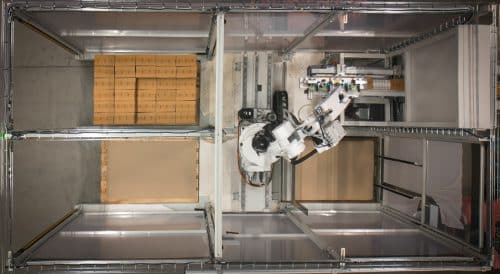
– We therefore ask whether people need to share the robot’s workspace during the palletizing operation itself. If the task can be performed in a safeguarded cell, there are good conditions for designing an efficient flow around an industrial robot.
Can a cobot palletize without safety fencing?
– In some applications this may be possible, but it cannot be determined solely from the fact that the robot is a cobot. The end-of-arm tooling, products, pallets and surrounding environment must also be included in the risk assessment.
– A heavy case in motion, for example, presents different hazards from the robot arm on its own. Both the protective measures and the space requirements must therefore be assessed for the complete installation.
What does payload capacity mean for palletizing?
– We need to calculate the total payload, including the end-of-arm tooling. Looking only at the weight of a case is not enough.
– In some production flows, there are also advantages to picking several products at once. This can reduce the number of robot movements required to build a pallet. In turn, this places demands on payload capacity, end-of-arm tooling and how the products are grouped before the pick.
– Reach is also important. The robot must be able to reach every position in the pallet pattern and accommodate the required pallet heights.
Is an industrial robot more reliable than a cobot?
– There is no general answer. Operational reliability depends on how well the complete solution is matched to the application and how it is maintained.
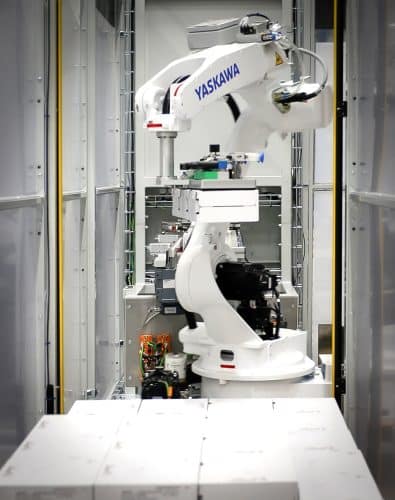
– A fast robot does not help if the cases arrive in the wrong orientation, the end-of-arm tooling is unsuitable for the packaging, or a full pallet blocks the outfeed. Product infeed, end-of-arm tooling, pallet handling and controls must work together as one system.
– We also focus on the operator’s day-to-day experience. Alarms should be easy to understand, and it should be clear how to correct the cause and restart the system safely. Service access, spare parts and support need to be considered from the outset.
When is a cobot a good option for palletizing?
– A cobot can be a good option when it meets the requirements for throughput, payload, reach and safety. Easy changeovers and the ability to adapt its use may also be valuable, depending on the solution.
– Both industrial robots and cobots continue to evolve. We therefore need to compare specific solutions for the customer’s application. For high-throughput production and heavier handling, however, there are strong reasons to evaluate an industrial robot at an early stage.
What should a company establish before selecting a palletizing solution?
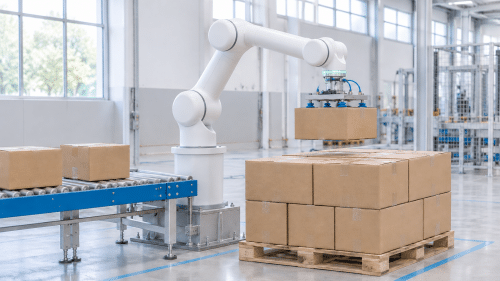
– Start with today’s requirements and the changes you expect in the future. A good specification includes product dimensions and weights, required throughput, pallet patterns, pallet heights and the available floor space.
– Also describe how the work around the palletizing operation is organised. How are empty pallets supplied? Who removes the completed pallets? Are slip sheets required? The better we understand the day-to-day operation, the better we can design the solution.
Shape’s perspective: Palletizing should be assessed as part of the production process
The choice between an industrial robot and a cobot has implications for the entire production flow. A solution that only just meets today’s required rate may leave little headroom for future changes. At the same time, the investment needs to be proportionate to the actual requirement.
At Shape Process Automation, our starting point is therefore to understand the process from incoming product to completed pallet. When high throughput, heavier handling and capacity for future volume growth are priorities, an industrial robot is often a strong choice. Operational reliability is then achieved through how the complete system is designed, operated and maintained.
Ask your questions
Would you like to discuss whether an industrial robot or a cobot is the right choice for your palletizing application? Contact Shape Process Automation and tell us about your products, production flow and throughput requirements.
Explore our robotic palletizing systems and see how we design complete solutions around your production flow, products and future capacity requirements.