

40 years of robotic waterjet cutting – and customers around the world
When Mikael Schröter began working as a robot programmer in 1986, robotic waterjet cutting was still a young technology. Forty years later, both the technology and the company have changed fundamentally. Mikael has been part of the entire journey – from the first robotic systems in Ronneby to today’s international business with customers around the world.
In fact, the story began somewhere entirely different.
Mikael had wanted to become an engineer from an early age, but initially, his grades were not sufficient for admission to an engineering programme. Instead, he began working as a bank clerk. It did not take long, however, for him to realise that it was not the right path for him.
At the time, work experience could provide additional points when applying for higher education. This gave Mikael another opportunity to follow his original plan. After completing his engineering degree, he received the phone call that would mark the beginning of a 40-year career.
A new field with great potential
The year was 1986, and the company was called Best Matic. Nils Rosenqvist had noticed that Mikael was a qualified engineer who also spoke fluent German. The company was expanding in Germany and needed someone who could train its German customers.
“Best Matic was considered a very exciting company at the time. Working with industrial robots was something new, and robotic waterjet cutting had only been in use for a few years,” Mikael recalls.
He began his career as a robot programmer. In photographs from that period, he can be seen wearing the supervisor’s coat – a sign in the 1980s that someone held a slightly higher position than those working on the shop floor.
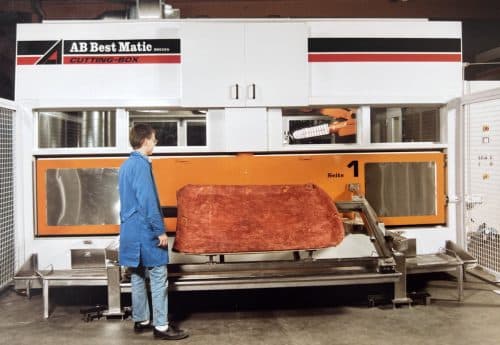
“That was simply how things were back then,” Mikael says with a smile.
From robot programmer to Service Manager
In 1991, Mikael became a Project Manager and also took on a role providing technical support to the sales department. By then, the business had become part of ABB I-R.
Three years later, he was given the opportunity to become Service Manager, a position he would retain until 2017.

During those years, both the company and its service organisation grew considerably.
“When I started, the service department had annual revenue of around SEK 1 million. By the time I left the role in 2017, that figure had grown to approximately SEK 90 million.”
During the company’s strongest years in the 2000s, it purchased between 100 and 150 ABB robots annually and generated revenue of approximately SEK 220 million.
“We were kings when we visited ABB,” Mikael says with a laugh.
The journey has also included more challenging periods. The financial crisis had a severe impact on the business, and in 2009, the company was forced to make significant cutbacks.
“The market recovered so quickly that those who had been made redundant had barely made it out of the door before we had to ask if they could come back.”
A spirit that has endured
During Mikael’s 40 years with the business, the company has operated under several names, owners and organisational structures. One thing he remembers particularly clearly from the early years is what the employees called the “Best Matic spirit”.
“Everyone worked towards the same goal and shared a strong determination to succeed. That is something I value and recognise today following the merger with the former Evomatic, which had the same spirit.”
During the ABB I-R years, the initial objective was not solely to generate a profit. The business was also tasked with establishing ABB robots within the European automotive industry and building a market for I-R’s high-pressure pumps – a business that later became KMT.
Today, KMT remains a sister company to Shape Process Automation within Shape Technologies Group.
“It has been an incredible journey. I have been able to follow robotic waterjet cutting from a small company in Ronneby to an internationally established business with installations around the world.”

The waterjet is the common thread
The waterjet has been the technical constant throughout Mikael’s career. Almost everything around it, however, has evolved.
Robots have become faster and more advanced. The company’s expertise in software, robot programming and process development has grown. High-pressure pumps have also made significant progress – from approximately 3,000 bar in the early years to today’s levels of up to 4,100 bar.
“I have had the opportunity to test many things and contribute to the development. Even though the technology has existed for a long time, I still see new markets and applications for waterjet cutting.”
It is the combination of robotics, process expertise and the ability to adapt a solution to different materials and applications that has kept the work interesting.

The customer has always come first
In 2017, Mikael left his position as Service Manager and became Senior Sales Manager, the role he still holds today. For him, however, the move into sales was not as significant a change as it might appear.
“In reality, I have worked with customers throughout my entire career. Regardless of the role I have held, the customer has always been at the centre of my work.”
During a visit to India, he encountered a phrase that stayed with him: it is the customer who gives a company the opportunity to develop. He has carried that thought with him ever since.
“It is about listening, understanding the customer’s problem and helping to find a solution. Working in sales is great fun.”
In recent years, his work has taken him to customers across much of the world – from Europe to India, Thailand and South Africa, as well as the USA, Mexico, Argentina and Brazil.
These journeys have given him a deep understanding of how business and customer relationships work across different cultures.
“You need to be humble and respect local customs. If you are invited to a two-hour lunch with a really good wine in France, you understand that the deal may be decided there – not in the conference room.”
In India, ceremonies held in connection with an installation are an important part of the relationship. Mikael took part in the ceremonies marking the delivery of both the first and the tenth waterjet cutting machine to Supreme in India.

Meetings with German customers during the 1980s and 1990s could also be quite different from today’s business trips.
“Back then, customers might want to enjoy a sauna, experience the Swedish countryside and perhaps have a small schnapps,” Mikael says with a twinkle in his eye.
Four decades of development
When Mikael reflects on his 40 years with the business, no single title or event can fully summarise the journey. Instead, it is the opportunity to continue developing alongside the technology, the company and its customers.
He began as a robot programmer when robotic waterjet cutting was still something new. Since then, he has worked as a Project Manager, provided technical support to the sales department, served as Service Manager and taken on his current position as Senior Sales Manager.
The company has changed both names and owners. The market has grown, faced periods of crisis and found new opportunities. Today, its customers are located around the world.
Some things, however, have remained the same: the waterjet, the determination to solve problems and Mikael’s curiosity about the next customer and the next application.
“I have had the opportunity to work with development and with the customer at the centre, for a company and with a product that I have been able to feel proud of.”
That may be the simplest explanation for how four decades can pass so quickly.

Want to know more about waterjet cutting? Read more>